Monday, November 11, 2013

Cruise Experience (Oct 28 - Nov 4)

This seven day cruise (Oct 28-Nov 4) starting and ending in Venice fit perfectly in our schedule.  After finishing our sightseeing "marathon" in Budapest, (some 400 miles in a straight line NE of Venice, but 800 miles the way we did - via Milan.) we needed to be on the ship, Costa Magica, in Venice by 4 PM on Oct 28 for a 5 PM departure.

Mon Oct 28 started very early.  In Budapest, we woke up at 3:30 am to catch airport shuttle (2500 HUF,  or $12) at 4 am.  The airport was only 15 km away, but took half an hour to reach the airport.  Our 6:05 am flight on Wizz Air returned us back to Milan Malpensa (MXP) airport on time, at 7:45 am.  We landed at Terminal 1.  My backpack was waiting at Terminal 2 - some 5 km away, at EasyJet's lost luggage office.  (It wasn't really "lost," I just hadn't picked it up when we arrived at Milan two days earlier.  I didn't need it for this one day trip to Budapest.)  We took the Free Shuttle bus that runs between the two terminals every 10 minutes, to Terminal 2.

In Terminal 2, there was no one to talk to, or a white courtesy telephone that I could find.  Arrival doors opened only one way, and no one was allowed to enter.  So I walked over to the Departure baggage check-in instead, showed them my luggage tag and asked where I could pick my bag.  The nice man at the counter made a couple of phone calls, confirmed that they have my backpack, and directed me back to Arrival.  As I returned, two police officers walked in behind me.  After checking my passport, they escorted me inside the Arrival Baggage Claim Area.  There were just a handful of bags "Left" like mine.  The attendant had me sign for the bag, and that was it.  Took much longer than anticipated, but it saved me the trouble of hauling my backpack to Budapest and back.  (Airports and Train Stations generally have a separate Left Baggage service, where you keep bags for, say, €5 for first five hours and 70 cents per hour after that - which adds up to €15-€20 per day.  It is a great convenience, and we used it from time to time.  Better and cheaper option is to drop your bags off at your hotel where you are staying that night.  They will hold your luggage for the rest of the day.)

Like the previous time, we took Milan Malpensa Shuttle bus that runs every 20 minutes, and for 10, drops you just outside Milan Centrale (main) train station.  After a nice 45 minute nap, we were in Milan.  We still had a couple of hours before our 12:05 PM train to Venice.  (We asked if we can take earlier train -- NO.)  We spent that time just watching trains and people go by - an interesting way to pass time, if you can enjoy it.  Each person, it seemed, was on a mission of their own, and they were going about it - unconscious of whatever else was going on around them.  There were just as many people going left, as there were going right.  They were locals going to work or school, or travelers hauling their luggage running to catch their trains.  

Our train coming from Genoa was delayed by about half an hour due to some police action.  Naturally. we were late leaving Milan.  We had Economy First Class tickets (which cost the same as Regular Second Class tickets) - our assigned seats were spacious, reclining, with large window views.  Food was available for purchase.  The way major train terminus are set up - Florence, Rome, Naples, Milan, Venice to name a few - a train enters the station and dead ends.  So when leaving the FRONT of the train becomes BACK. We were in Car #2 from Front in Milan - we had to walk only two cars to get to our seats.  When we reached Venice, though, we were Car #2 from the back and had to walk 12-14 cars to get out of the station..
  • VENICE, Italy: Our superfast train (No. 37) was to cover 264 km in about 2 1/2 hours, stopping at select stations like Verona, Vicenza, Padova (each of them could have been a nice 1/2 day sightseeing stop.)  Scheduled arrival at Venice S. Lucia train terminus was 2:40 PM.  We reached at 3:25 PM.  The Cruise Ship was less than a mile (20 minutes walking) away, so we had enough time.

    Once outside the train station, we crossed the first bridge on the right to get to P. Roma - the main bus station as well as stop of Veporettos (Venice's waterbus.)  This bridge has a modern glassy transparent look, and has small steps as well as ramps for wheelchairs or luggage.  The next bridge to the right, which connects Venice to the mainland, also connects to the cruise port (we walked back that way a week later.)  Or, there is an automated People Mover that, for €1, would transport you to the Port/Docks.  In the past, you'd have to take Veporetto for one stop (6.5) to get to the port.

    Although the ship was right in front of us, signs to Costa Magica pointed in a different direction.  That's where we were to drop off our luggage (with our room number tags) before boarding the ship empty handed.  It was about 4 PM, and it was finally time to relax.

    Inside the port entrance building, they checked our tickets, health questionnaire, then security check, then mandatory Ship photos, then walk up the ramp, finally reaching the entrance to the ship on Deck 3.  Here EU citizens just showed their EU cards and walked in.  Everyone else had to hand over their passports.  It is a bit unnerving NOT to get your passport back right away.  We were told that passports will be returned just before we disembark one week later.  During the cruise, we needed one and only one ID card - the ship's card that also served as your room key, debit/credit card for on-board purchases and "passport" for shore excursions.

    For those who boarded the ship earlier in the day, there was a Welcome Buffet lunch on Deck 9 from Noon onward.  When we boarded at 4 PM, we did not know what to do or where to go.  As it turned out, we just had to go to our rooms for further instructions.  Our luggage would be delivered there shortly.  The room had our ID cards - pre-printed with our names and room number, daily newsletter giving us all the details about the times and activities for the day, AND red Emergency Drill cards.

    As required by international law, everyone on board must go through emergency drill before the ship sails.  Remember Titanic?  At 4:30 PM, we were directed to walk up to Deck 5 (where all the lifeboats are) wearing our life jackets, line up 5 deep, and listen to announcements made in five languages.  We handed our red cards as we entered our designated muster station D as a proof of attending the drill.  Soon we were dismissed, and the ship left Venice.

    Best views of Venice are from the open decks 10, 11,12 of the ship.  It was just getting dark and city lights were coming on.  Gliding past St Mark's Square and around Lido, we were in open sea.  Soon it was completely dark.  Having nothing to see outside, people went around their business inside.

    First thing is to do on a cruise ship is to orient yourself to the ship decks, event locations and amenities.  Deck 9 for buffet and swimming pool/Jacuzzi; Decks 3-4-5 for Urbino Theatre and Dinner Venues are a good start.  At 7:30 PM, we decided to check out the entertainment show Voyage.  These daily one hour non-stop action-packed variety shows are great for passing time while waiting for your designated dinner time.  After the show, there was still half an hour left before the doors opened for second seating at 9 PM.  This was a good time to enjoy the piano in the 10 story atrium and check out your ship photos.

    Our Dinner Table was 410 - we were curious to find out who our table mates were going to be.  There were very few English speaking passengers on-board, but all six at our table were - all from the U.S.  We hit it off quickly and looked forward to meeting at dinner daily to exchange stories and discuss next day's shore excursions.  Jonny and Morgan had similar interests like ours, so we ran in to them often.  George and Amanda were adventurous and spontaneous - like riding a scooter in Olympia and donkey ride in Santorini.  Everyone except me had already been to Venice.  I will get my chance next week.
  • BARI, Italy: 
    Bari is roughly 150 miles straight East of Naples, and NOT high on our list of destinations.  Several passengers began their seven day cruise here instead of Venice.  It's all the same for the cruise line, since these cruise ships repeat the same itinerary over and over, like bus service.  George and Amanda wanted to explore Croatia after the cruise - so they got off at Dubrovnik, a day earlier, and went on their way.

    - All our destinations, except Santorini, had cruise ports large enough for our ship to dock.  These days, Port (left) vs Starboard (right) distinction is not that meaningful.  Cruise ships dock on either side depending on the availability of the berth.  Bari has a large cruise port, so we docked close to town, and walked on to the places we wanted to visit.

    - The old city is very close to the port, and has the most important monuments such as Saint Nicholas (inspiration for Santa Claus) Basilica, Cathedral and the Castle.  The roads are narrow, winding and easy to get lost in the old city.  It is not easy to spot even landmarks or which way the ocean was, once inside this maze.  Our GPS worked well enough to find our way through.  The Castle is now a museum.  Beyond the old city, roads are on a grid pattern and easy to navigate.  We walked by the shoreline some ways and returned to the ship.  This was our first shore excursion - and without taking the guided tour with the Cruise.  Now we knew how to manage the whole process - getting off the ship, reaching the town, finding out what to see in what order, when to return back to the ship, etc.  Of course, each destination had a different twist to it, but we managed it just fine.

    - Back on the ship, our routine was set.  Have breakfast, go ashore, skip lunch, have evening tea, attend 7:30 PM entertainment show, and dinner at 9 PM.  Swimming pools were tiny and crowded during the day, and cold at nights.  Even the Jacuzzi were crowded even though the water was not warm enough.
  • KATAKOLON, Greece: 
    Starting Line at the original Olympic Stadium
    Katakolon is a small port founded in the first half of the 19th century and linked to the legendary Ancient Olympia nearby.  Travel guides suggested that Olympia was far enough from Katakolon port, and not easy to get to.  So rather than spend time figuring it out, we decided to take this (and the only) shore excursion through our Cruise Line (€52 per person.)  If we had gone on our own, as Jonny/Morgan did, local bus would have been €8.  George/Amanda rented a moped.  Various possibilities.
    - Cruise ships, of course, have shore excursion part organized well.  That's how they make money afterall (and on drinks.)  We were asked to be on Deck 5 by 1:30 PM, where we were given a sticker "C 29" for Costa bus no. 29.  We were asked to proceed to Deck 0 to exit the ship after scanning our Costa Card.  A row of buses were lined up in numerical order.  Our tour guide collected our tickets, and after everyone was on board, we left for Olympia 40 km away.

    - Our guide educated us on the history of Olympia and Greece in general.  Greece's main exports are cotton, grapes/wine and olives.  Tourism, certainly, is a big boost to Greece's economy.

    - Within 40 minutes, we were in Olympia.  We were given entrance tickets to the Archaeological Find, as the site is called.  Germans led the excavations in the 19th century of this birthplace of Zeus, king of gods.  The city is a pastoral site chosen by Zeus to promote his culture among the Greeks.  Olympic Games originated here and, according to the Hellenic tradition described by the Greek poet Pindar, their origin is in honor of Pelope, a legendary character, after whom the Peloponnese was named.  Only men participated in those games - in the nude.  (Zeus's wife Hera held similar games for women.)  Games were held every four years at summer solstice, lasted for a few weeks.  During this time, all conflicts had to be suspended to enable the performance of the games.  All competitors had to be Greek. Winners were awarded by public triumph - they were included in a golden register engraved in stone and a life size statue was erected for them.  (Later, Nero took 20,000 of them to decorate Rome.)  And of course the Olive wreath.  After over 1200 years of continued history, the Games were stopped in 393 AD by Theodosius I, and started again in Athens in 1896 upon initiative of the French Baron Pierre de Coubertin.

    - At the start of the games, women dressed in Greek attire (even today) would lit the torch in front of the temple of Hera, and bring it inside the stadium to indicate the start of games.  These days, the torch is lit with solar mirrors and then taken inside the stadium.  From there, it goes to the tomb of Pierre de Cubertin, and then to Panathenaic Stadium in Athens where these games were played for centuries.  Now-a-days, International Olympic Committee decides how to take the torch to the venue of current Olympics from Athens.  After 1896, games were held elsewhere until they returned to Greece in 2004.  In 2004, one event - discus - was held in Olympia.
    - The naturally sloping Olympic stadium is very impressive, with an audience capacity of up to 45,000.  It is still possible to see the starting and finishing lines of the races in the stadium.  The distance between those lines (197 meters) was called one Stadium.  We ran the distance, and have photos to prove it!  All archaeological finds are preserved in the adjacent Museum.

    - After exploring Olympia Archaeological Find, we wanted to visit the museum (Not included in our tour.)  So instead of taking the bus to the town for shopping, we ran over to the museum.  It was small, but very well laid out.  Most importantly, it gave us a much better idea of what Olympia looked like before it fell apart.  Pediments, the triangular portion on top of the columns, of the Temple of Zeus - almost entirely complete, as well as statues, tools, weapons, toys, utensils are preserved here.  This entire area was covered up by several feet of dirt on top.  Thanks to the hard work of archaeologists, we now have a chance to experience this history.

    - Jonny and Morgan were at the museum as well.  We wanted to make sure that we don't miss our buses, but we all made it to the ship on time.
  • PIRAEUS (ATHENS), Greece: 
    Parthenon
    Cradle of Greek civilization, today's Athens is a bustling, frenetic, modern city with six million inhabitants - nearly 1/3 of the total population of Greece. Port of Athens, Piraeus, is very much an integral part of the city.  Although Athens is a huge, sprawling city, much of its political, historical and administrative life is concentrated in a small area including Syntagma (Constitution) Square, the Acropolis and Omonia Square.

    - According to Greek mythology, the establishment of Athens was the result of a dispute between the goddess of wisdom Athena and her fellow gods, under which the city was given as a peace offering. In historical terms, the city was founded by the Phoenicians at least 2,000 years before Christ. The founding fathers of democracy, Athenians had to go into battle many times to defend their freedom and built up a mighty military strength.

    - Between 400 BC and 1400 AD Athens had been raided, sacked, and burnt at least 30 times. Gradually, Athens was rebuilt and by the end of the 19th Century, its fortunes had greatly improved, culminating in the revival of the Olympic Games in 1896.

    - The Acropolis, overlooking the city of Athens from the top of a rocky hillside, is the dominant monument of ancient Greece, the site of the first temple dedicated to the goddess Athena and the stunning Parthenon. Among the magnificent ruins of the Acropolis, and the fascinating artifacts of the Acropolis Museum, the ancient civilization surrounding the Parthenon, Herod Atticaus Odeon, Dionysus Theatre, Muses Hill, the Agora, Hephaestus Temple and the Apostles Church come to life.

    - We had an entire day in Athens.  Metro to Athens comes about a mile from the port.  As we exited the ship, we turned left following the curving road from our gate 12 to gate 5, until we reached the train station.  A 4 pass, good for 24 hours, had to be validated just once.  Ticket was checked only once when we switched from Blue line to Green line.  Bus/tram drivers didn't bother to check tickets.

    - The rickety train made many stops and took a long time to reach Athens.  We got off from Green line at Monstiraki to switch to Red Line to go to Acropolis, but found out that we were near the Ancient Agora, which closes early at 2:30 PM, so we decided to visit that first.  As we exited the train station, we were in the middle of what looked like a flee/farmers market (Agora?)  Being in Greece, our Italian phone/GPS wasn't working.  We didn't have a paper map either.  Asking around, we found out that the Agora was only a block away.  We also found a travel agency, and got a map.

    - It is best to start the tour here at Agora, because there are no lines.  In fact, it didn't even looked like it was open - though the gates were.  One joint ticket for Agora, Acropolis and several other sites (12) got us in.  Temple of Hephaestus is the most complete standing temple in Greece.  (Those in Sicily/Agrigento were even better!)  The remaining buildings around are in ruins.  Statues are archived in the adjacent museum.

    - Exiting from the back, a 10 minute hike brings you to the entrance of Acropolis.  There were plenty of tourists here, but the line to enter was not too long.  Another 10 minute hike up the steps brings you to the top of the hill and the actual entrance to the historical Acropolis.  During summer months, we were told that it is so hot that tourists avoid going to the top.  There is so much history in Acropolis, but scaffolding and cranes come in the way.  The place is being restored all the time.  Like Olympia, most of Parthenon is empty - and we couldn't enter.  To see what was inside, you visit the Archaeological Museum at the bottom of the hill.  Within the walls of Acropolis, you have to read signs to understand the history of the place, unless you take a guided tour.  Parthenon was originally a Pagan Temple, which was later converted to a church and then to a mosque, before becoming a tourist attraction.  Even though the temperature was mild (70 degrees) it felt hot on the top of that barren rock.

    - We walked down to the modern building of the Museum, which is built on top of archaeological digs at the bottom of the hill.  Glass flooring at various spots gives a glimpse of life in Athens centuries earlier.  A short walk a couple of blocks away is the remnant of temple of Olympian Zeus - as part of a large park.  Further down, some distance away is the impressive Panathenaic Stadium - an all marble stadium - where the ancient games were played - and some modern ones.  A short tram ride took us to the Constitution Square and the Parliament Building.  We also walked through the adjacent park, but there was nothing to see.  Having seen pretty much all we wanted to see in Athens, we returned to the Ship.

    - Metro ride back to the port was uneventful.  Just outside Metro station, the first bus that came along happened to be the right one.  It dropped us next to our gate, so we were back on the ship in no time.
  • SANTORINI, Greece:
     
    Oia
     
    One of the Cyclades islands, Santorini is a spectacular jewel of the Aegean. Born out of a volcanic eruption in approximately 1500 BC, which formed the two islands of Aspronissi and Terrasia, Santorini is a magnificent mixture of dramatic cliffside villages, glorious black sand beaches and ancient treasures. Steep cliffs plunging into a crystalline sea distinguish the west coast, while the east coast is gentler, featuring a fertile plain and delicate bays, with the Profttis Ilias mountains in the background.  There is even an airport there.

    - Archaeological investigations have shown that the 69 kilometers of coastline of Santorini was probably inhabited in prehistoric times, while the first chronicled civilization to live on the island were the Phoenicians.  Through the centuries, the island continued to fall under different rulers, including the Spartans, Athenians, Byzantines and Turks.  Commencing in 1967, ongoing excavations near the pink sand beach at Akrotiri have revealed the ruins of ancient Thera, the center of population on the island before it was destroyed by the volcanic eruption.  Among the extensive remains are ceramics, stone and bronze tools, ornaments and small artworks. A series of frescoes suggest a highly-developed community. Some researchers believe it is the site of the mythical lost city of Atlantis.

    - On the North side, one of the prettiest spots on the island is the village of Oia (pronounced I-A), a network of narrow marble-paved alleys, lined with yellow and blue domed houses, and extraordinary views out to sea.

    - We had only half a day (7 am to 1:30 PM), but wanted to visit both Akrotiri as well as Oia, on two opposite sides of the island.  Shore excursions would take us to only one or the other.  So, we decided to do it on our own.

    - Santorini was the only stop on our cruise where the port was too small for our ship to dock.  Instead, it was parked in the quiet waters in the caldera of this ancient volcano about a mile away, and tenders (small boats that could accommodate 100 people at a time.) would take us ashore.  Those taking shore excursion were off the ship at 7 am.  For the rest, we had to get tickets for 8 am departure.

    - We were on the first tender, and enjoyed the 10-15 minute ride to the port as we approached this beautiful island.  It is said that for views ONLY, the best place is in fact your cruise ship top deck.

    - The water was choppy at the dock (it was much worse when we returned in the afternoon.)  From here, we had a 500 meter climb to the top.  Aside from hiking to the top, there were two other options - a donkey ride (€5) or cable car (€4).  To optimize our time, we took the cable car and found our way through the alleys of town to the bus station.

    - The first bus of the day to Akrotiri was at 8:45 am, and found a few others with similar interest as ours were going for the ruins of Thera.  There were just a few locals on the bus.  Within half hour, we were dropped in front of the Archaeological Find.  It was open, and those who took the Shore Excursion were already there.  A nicely built, privately funded museum showed how three story stone homes survived the volcanic explosion, and displayed other items found there.  The remaining items, as usual, were stored in the Archaeological Museum in Fira - where we started our journey on this island.

    - After the museum visit, while waiting for the return bus, we saw signs for the Red Sand Beach and followed the signs to it.  It took us to a vista point from where we could SEE the beach - but the way to the beach itself was from another side.
    Red Sand Beach
     Soon after we returned, the next bus arrived and took us back to the main bus station in Fira.  Within minutes, bus to Oia was leaving.  Though the distance to Oia was about the same as to Akrotiri, this bus ride took longer.  It was later in the morning, and lot more locals were up and about as well.

    - Oia is well known for watching sunsets, but we wouldn't be here that long.  Yet, it is well worth the visit for watching those white houses perched on the cliffs and amazing views on all sides.

    - It was 1 PM.  We rushed to get back to our ship on time, only to find that there were far too many people still waiting in line - first to get on the cable car down to the port, and then another long line to get on tenders.  Water being too choppy in the afternoon, loading up was taking too long.  Had we known beforehand, we could have easily hiked down the donkey path.  Jonny and Morgan did just that.  George and Amanda told the story of donkey racing on the way up to the top.

    - We all have heard fascinating stories about Greek islands, and seen them in the movies.  If you have to pick just one, Santorini would certainly make the list.
  • CORFOU, Greece
     Corfu is the northernmost of the Ionian Islands, located in the heart of the Mediterranean. The Greek place name Kerkira was renamed Corfu by the Venetians, who paraphrased the word “Korifi” which was used.to indicate the towers of St. Mark’s fortress.  Corfu is covered in lush vegetation, thriving in a climate that is tempered by the wind without being too dry. Its coastline is very long, seemingly never-ending: over 200 kilometers. The terrain is quite varied, at times sandy and at others rocky and broken up by Mediterranean bush, olive, cypress and citrus trees.  Corfu has suffered a long and bloody history. Corfu embarked on a long period of being colonized by others from 700 B.C. onward, first by the Corinthians, then the Illyrians and the Athenians. Corfu suffered attacks from pirates while under Byzantine rule forcing the relocation of the city northward. This did little to halt the invasions of the Vandals and Visigoths, who repeatedly massacred the populations and razed their villages to the ground.  The Venetians gave Corfu back its status as an important center of trade and with it a very wealthy market. Venetian rule lasted for more than 400 years, during which time the island was governed by a system of aristocratic rule. The Venetians began the cultivation of olives and to this day, Corfu is one of the main olive oil producing centers in the region. Once the Venetian reign came to an end, it was the Turks’ turn, then the French and the English, and on 21st May 1864, it was annexed to the Kingdom of Greece.  During the Second World War, Corfu was again bombarded and suffered heavy damage. Most of its buildings were destroyed, such as the public theater and the Ionian Academy. Just a few outstanding buildings remain, scattered along the coastline and in the main town and jealously guarded by the local population.  Kerkira is the capital, and accommodates around 60,000 of the 110,000 people who live on the island. The city has numerous Venetian fortresses and the English Royal Palace. The rest of the island is made up of small settlements, roads that stretch out high above the sea and splendid views of small bays and magnificent cliffs.
    - After getting off the ship, we had an option was walking over to the old castle and Kerkira town, OR to take the local bus to the West coast of Corfu several miles away to Paleokastritsa for the peaceful cove and Monastery.  The buses are coordinated to make sure that tourists get back on their ships on time.  We had seen enough castles and old towns, so we opted for the second one.
    - Paleokastritsa is a nice, quiet community with calm beach and water for boating or swimming.  Views from the Monastery were breathtaking.  Certainly worth the trip.    
  • DUBROVNIK, Croatia:
    Walls of Dubrovnik.  Border of Bosnia Herzegovina just beyond the hills behind.
     
    A charming port by the Dalmatian coast, set in front of a picturesque hillside, Dubrovnik is one of the most attractive destinations on the Adriatic Riviera. It has been extensively restored since suffering during the Balkan hostilities of the 1990s and, some would say, is more beautiful now than ever. The city’s style and architecture is strongly rooted in its historical Venetian and, to a lesser extent, Turkish influence. This part of the Dalmatian coast played a vital role in the success of the Venetian Republic.

    -  The most attractive section of Dubrovnik is the old city, Stan Grad, lined with cobbled streets, fountains, museums and churches. The largely intact city wall, some of which was built 700 years ago, is one of the finest examples of its kind in the world. The importance of religion in the city’s past and present culture is reflected in a number of impressive Franciscan and Dominican convents and churches.

    - As our ship approached the port of Dubronik, navigating through the narrow channel, we saw a bridge straight in front of us.  It didn't look like our ship would clear under the bridge, but we weren't sure.  Our ship stopped just short and then made a backward 270 degree turn so it was facing the way out of the channel.  It then backed in and gently touched the port on starboard side and parked.  And I have trouble parallel parking my car!!!

    - From the ship, we took a shared taxi (€5) that dropped us just outside the old city.  As you enter the city gates, one of the three stairs to the top of the wall are on the left.  (€16) This is the best place to begin the walk on the wall - which goes only one way (counter-clockwise when seen from top) towards the ocean first.  Ocean views are the reason to walk the walls.  There is also a cable car outside the walls that takes you to the top of the hill behind. (€15)

    - Although Croatia had just joined the Eurozone in July 2013, conversion of the currency to Euro isn't scheduled until 2015.  In the meantime, Croatians proudly declare that they do NOT accept Euros, just their currency Kuna.  This is not a problem where credit cards are accepted, such as at the walls.

    - The day was pretty nice and clear, with some clouds floating through.  The temperature was mild, though the winds made it feel much colder at the ocean front.  It was a Sunday so most churches were having masses, but we were able to poke our heads inside for a quick look.  For such a small town, there were plenty of churches to go around.  It was also nice walking along the harbor.  The rest of the scene looked just like Florence, Venice etc. - shops lined on both sides, tourists walking around and shopping or eating.

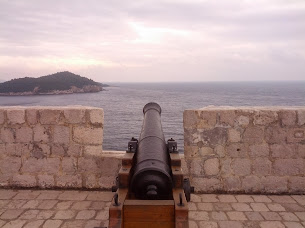
    - Outside the old city, only a few hundred feet away is a small castle - more like a watch tower.  You have to climb quite a few steps to get to the top, so not many people go there.  Entrance fee to the Walls includes entrance here.  That was the best vista point in town - and peaceful too.
     Photo
    - To come back to the ship, we exchanged some euros to get 24 Kuna change for the local bus.
  • VENICE, Italy: As usual, I went up to top decks to see the sunrise, and to have breakfast.  We had to vacate our room by 8 am (so the crew can clean it up and get it ready for the next wave of passengers later in the day.)  Venice was already in sight.  Venice and surrounding islands lie within Laguna Veneta (Venetian Lagoon), with Lido - 7 mile long sandbar - separating it from the Adriatic Sea.  There is so much traffic inside the lagoon and other dangers (shallow water, rocks or islands), that the ship slows down to 5 Knots, with a pilot guiding our ship to the port.  Pilots - one in front, other behind - stay far (1/2 mile) away from the ship when they come to meet with the ship in open seas.  But as we entered the lagoon, they were almost touching the ship - so no other boats could cross in front of our behemoth the ship accidentally.  So the final few miles take a long time (45 minutes or so) to cover.   That gave us opportunity to enjoy the view of Venice from different angles as the sun was coming up.  Soon, seagulls started following the ship, eventually scrambling to eat any food left unattended on the top deck.  We were scheduled to arrive at Venice at 9 am, and sure enough we were at the port on time.  To avoid mass exodus, we were assigned colored luggage tags so only a handful of people from each floor would be getting off the ship at one time.  For those carrying their own bags, like us, there was no assigned time.  We wanted to get out as soon as possible to have the whole day in Venice (Rain was on the way later in the day, but we didn't know that.)  So we went downstairs as soon as the ship docked.  We had to scan our ship's ID card one last time to exit - and then keep it as a souvenir.  We had already picked up our passports the previous day, after our last port of call in Dubrovnik.  Great Cruise Experience (and, not to mention, too much food!)
For more, see Tidbits.

Sunday, November 10, 2013

Accidental Cruise!!!

Never say never!  

My first -and what I thought was my last- cruise was in Nov 2006 - a 4-day cruise to Ensenada, Mexico from Long Beach, CA.  Before that, my only seafaring experience was an overnight trip at age 12 - all I remember was that the sea was rough and I was seasick the entire time.  I was assured that I will not have to worry about that this time, because today's cruise ships are much larger, more stable and therefore, the ride is much smoother.  Turned out to be all true.  My main purpose for that cruise was to explore employment
possibility in the travel industry - get paid while doing what you love to do -- travel.  However, just about everyone on the ship echoed that life on cruise ships is very hard, and that the best way for me to enjoy the cruise is as a passenger.  While the overall experience was fine, I concluded that cruises are not for me.  There was far too much free time and too little to do (other than eat) - for my taste. 

Fast forward to 2013 - while planning this, a more-or-less backpacking trip through Europe, I was having trouble fitting Greece in to our schedule.  Then, I stumbled up on this cruise to Greece - Athens, Olympia, (Delphi would have been a nice addition) and a couple of islands - it was a perfect fit.  Dubrovnik and Bari were bonus.  We tacked on the cruise at the end of our two-week mad dash up and down Italy, and voila, the itinerary was complete.  By the time we got on the cruise ship on Oct 28, we were ready to slow down and relax.

Cruises, as I'm sure you know, offer a way to travel with some substantial benefits and a few drawbacks.  Cruising makes it easy to visit several places in a single trip without having to repack your belongings and hop on to a car/train/bus/plane to the next stop; your hotel room comes with you, and even provides the transportation.  By visiting many locations, usually for a short day of sightseeing, you get a sense of places you'd want to revisit later.  There is usually a long period of time each day at sea: paradise if you enjoy relaxing by the pool, watch waves or sunrise/sunset, ponder the future of humanity, or just day dream; but frustrating if you prefer more active and open exploration.  
Evidently, the benefits outweigh the drawbacks for enough people to allow this industry to thrive.  Today, you can visit every continent on earth by cruise ships.  Due to economy of scale, most modern cruise ships carry 2,000 to 5,000 passengers.  
Costa Cruises, a Genoa, Italy based company, is one of the largest in the Mediterranean (now part of Carnival.)  There is no mistaking a Costa ship; easily identifiable by their signature yellow smokestacks sporting a giant blue “C.”  Costa Magica - Wikipedia

Our ship, Costa Magica, carries 2720 passengers - a third on our cruise were from Germany, rest from Italy, Spain and France, and just a handful of "English speaking" kind.  
All announcements were made in five languages (English, Italian, French, German and Spanish).  Costa Magica also carries a crew of about 1068 (1:3 ratio to passengers.)  Its claim to fame is spacious cabins, more than 5,500 Italian works of art onboard, and tasty international fare at Bellagio Buffet on Deck 9.  The interior theme of the ship is Italian holiday spots. Blown-up posters (computer manipulated to look like Impressionist-era paintings) of destinations such as Portofino and the Italian Alps line the walls.  Similar posters - many nudes - cover hallways and cabins.  All cabins have a tasteful décor and are outfitted with twin beds that convert to a queen, TV, telephone, hair dryer, safe, mini-fridge, closet and bathroom with shower.  And daily maid service.  Room service was available for 5 service charge. (Food was included anyways.) 

Even in late October/early November (shoulder season), I was surprised to see so many families on board with children ranging from very young to high school.  Rest were predominantly vacationing seniors.  The whole affair was casual - too casual at times.  People had to be reminded that walking around in just Speedos is NOT OK when they leave the pool area to return to their rooms, or to get food.  Even though there were signs prohibiting children under 16 from using Jacuzzi/hot tubs, they were in there at all times - with their parents!  The dress code was casual during the day, shorts were NOT OK in the evenings, with one formal night and one semi-formal night on a seven-day cruise.  But none of that was strictly followed.  I  just had a dress shirt and pants (was not able to fit a suit in my backpack,) but I was still more formal than many others.

Sit down breakfast was available on Deck 3, but most people quickly gravitated to Deck 9 Bellagio Buffet - it was open continuously from 6 am until 2 am next morning for something or the other.  It would open for early breakfast until 7:30 am, then regular breakfast until 10 am and late breakfast until 11:30 am.  By then, lunch would begin on the other side and go on until 2:30 PM.  From then on, Pizza and Salad were continuously available until 2 am - even during tea time 4-5 PM and two dinner sittings at 6:30 and 9 PM.  Swimming pools and Jacuzzi were also on the same deck.  It seemed some people never left Deck 9.  My guess is that 1/3 to 1/2 never left the boat at all - the cruiseship WAS their destination, just the way cruise companies prefer.


Breakfast and lunch were open seating on Deck 9, and assigned seating (in two shifts) for dinner on Decks 3 and 4.  There were tables of two, four or six spread throughout.  Our table had six - there was a seventh chair at one end without any place settings - just in case, I guess.  Next to us was a table for two.  At our table, we were all "English speaking," all from the U.S.  We joked about how we were but a small minority - 30 or so out of the 3000 passengers on board.  We had a great time together, exchanging notes about what we did that day, to tips on what to do the next day.  It seemed that we were almost always the last ones to leave dinner around 11 PM - there were just too many courses and we seem to order them all - Appetizers, Soup, Pasta, Main Dish, Cheese and Desert.  Although all dishes were visually appealing, taste was another story.  Fish and meats tended to vary greatly in quality, so near the end, we gravitated toward vegetarian choices.  I always asked our server for his recommendations, and that kept me away from some of the "bad" choices.

Cruiseships tend to attract large Indian contingent as kitchen staff (other major group was Philippinoes - waiters, servers and stateroom staff.), and our maitre d was also from India.  He agreed to special order an Indian meal for our table one night - a fixed menu of four items: rice, chapati, curry chicken and one vegetable.  They made it spicy, and it was the best meal our table had.  It was perfect.

What was true about the quality of dinner was also true about other meals.  Lunch buffet would have daily specials - Indian, German, Spanish, Greek, Italian, and so on, but the quality would be nothing to write home about.  Thankfully, we were away on shore excursions on most days and missed lunches.  Alternative to specialty lunch was hamburgers, hot dogs and fries - the fast food. Breakfast was the usual multiple choices - eggs, meats, toast, pancakes, pastries, cereal and fruit - also tea, coffee, apple/orange juices.  (On the ship, orange juice was the familiar yellow color; but in Italy, most orange juice was reddish - like grapefruit or guava.)  Two kinds of Pizza - cheese and pepperoni, and salad rounded out the menu.  Then there was ice cream, cookies and pastries at tea time (4-5 PM), and Gastronomical Delights each night at 11:30 PM on Deck 5.  It is no wonder why the ship seemed to sink a little deeper on the last day than the first!!!  (At least, people did.)

Costa has simplified "tipping" - no envelopes or cash needed.  Seven euros per person, per day are added to your onboard account automatically.  Of course, you may give an extra tip on the last night to the waiters, the maitre d's and especially the hardworking stateroom staff.  Overall, the
 service was excellent: prompt, efficient, friendly and courteous.  Even the shore excursion staff was friendly whether you purchased any excursions or not.
“Cruising Italian Style” - When I made the reservation for the cruise, my U.S. based travel agent mentioned “Cruising Italian/European Style” and adding "you know what I mean!" several times without actually explaining it.  Only later I found out that it features plenty of sun, fun and crazy activities - in other words, beer, bellies and boobs.  Although the weather warmed up to 60-70 degrees during the day, it cooled as the sun went down (around 5 PM after the Daylight Savings time ended.)  Outdoor pool would be empty as it got dark, only the indoor pool/Jacuzzi were crowded.  For water sport, there was a huge winding slide on Deck 11, but it was open only two hours a day (weather permitting). I never saw it being used.  Only one day, we were on the ship for lunch and noticed a lot of beer bellies.  There were sunbathers as well, but I didn't notice anyone topless.  So it wasn't as dramatic “Cruising Italian Style” after all.  May be that was more of a summer thing.

Evening entertainment was presented daily in the three-tiered Urbino Theater, with entrances from Decks 3, 4 and 5.  This hour long show would be held at 7:30 PM for second dinner seating group, and 9:30 for first seating.  It was a full Las Vegas style non-stop show with strobe lights, lasers and fireworks, rotating stage and special effects.  Two shows were mostly magic and acrobats, the rest were themed song and dance shows.  More often than not, the songs were in English.  One show was performed by the crew members.

(There were plenty of other activities on the ship that I didn't mention.)

Except for one day at dinner, the seas were calm or only slightly rough - we hardly noticed the movement.  I generally watched sunsets and sunrises each day.  For sunsets, I would find a quiet spot by the window and watch the sun go down directly in the water.  There would be no waves, no fish jumping out of the water, or any birds.  Only in Venice have seagulls discovered the pleasures of Bellagio's breakfast.  For sunrises, the sky would usually be partially cloudy or foggy.  The deck would be wet from the rains previous night (if any.)  Sun would rise from the fog or some distant hills of the land we were approaching.  The fog would clear up as the sun went up, and by the time we went ashore, it would be a nice clear, warm day.

The cruise ship had the top speed of about 20 Nautical Miles.  (Nautical Mile is approx. one minute or 1/60 of degree arc along any meridian on earth.  It is defined as 1852 meters or 1.151 miles.)  We traveled roughly 300 NM each day or about 15 hours.  That distance controlled when we reach a destination, and therefore, how much shore time we had, when we have breakfast each day, when we woke up and so on.  

To make it more interesting, we had time changes.  Europe ended Daylight Savings time on Sun Oct 27 morning.  That day, we were in Budapest and moved clocks back one hour.  Two days later, in Greece, we moved clocks forward because Greece is at GMT+2, and back again four days later when we returned to Venice, because Italy is at GMT+1.  By then, the US was also back on the Standard Time.  

For shore excursions, we typically had half days - except a full day in Athens (9 am-7 PM).  Bari (12:30-6 PM), Olympia (12:30-6 PM) and Corfu (Noon-7 PM) were afternoons, and Santorini (7 am-2 PM) and Dubrovnik (8 am-1 PM) were mornings.  This was just enough time to capture the highlights for each destination.  The rest of the time, we were blissfully going about our own favorite pastimes while being transported at 20 miles an hour.  In seven days, we traveled 1941 nautical miles or 2234 miles - about the same distance we traveled flying within Europe during this trip. 

For more, see Tidbits.

Friday, November 1, 2013

Ports we visited

Courtesy: Costa Cruises
  • VENICE, Italy: Venice is considered the city of art, romance and prestige. The extraordinary architecture was built on an archipelago of small islands separated by a network of canals crossed by approximately 400 bridges, once wooden and then replaced by stone. The Grand Canal is the main city artery. It is crossed by three bridges and has the shape of an upside down “S” dividing the city in two parts and in turn divided into six “sestieri” (districts): Cannaregio, San Marco and Castello on the left side; Santa Croce, San Polo and Dorsoduro on the right side of the canal. Water transport undoubtedly prevails over land travel, with gondolas, ships, ferries, and yachts serving as taxis to transport people and goods. There are few main roads and several small “calli” (narrow streets) developed along canals, “campi” (squares adjacent to churches), bell towers and “fondamenta” (streets along the canals) where motor vehicles are not allowed.

    Refugees from Spina Adria and Aquileia after the invasion of the Huns in the 5th century AD founded Venice. The Doge under the protection of the Byzantine Empire governed it by “maritime tribunes."  In the 9th century, the city became a very important commercial port, connecting the eastern and western markets through the Adriatic Sea. Its commercial power soon resulted in military power. Within a few years, Venice dominated all the east Adriatic coast, reaching the East, colonizing territories and conquering important markets, competing with Genoa and with the other Maritime Republics to assert its power. Turks chased the Venetians from many eastern colonies. The repercussions of the French Revolution affected this perfect aristocratic government where commerce and military power supported each other.  In 1797, Venice was weak and after the Campoformio treaty, it was subject to Austria and subsequently annexed by Italy.

    Grand Canal offers a quick view of the most beautiful palaces in Venice: the Academia, the Ca d’Oro, the Casino, the palace of the Biennial, the University, the Chiesa della Salute and the popular Rialto bridge, up to Piazza San Marco where the canal opens into a wide area. The square is the heart of Venice and its symbol. It is an architectural jewel and one of the most beautiful squares in Italy; a miracle built in trachyte and Istrian stone. In the past, religious and civil ceremonies took place in this square - and also the famous Carnival. At its end, there is the Basilica and the Clock Tower.
    Glass blowing is particularly interesting and takes place on the Island of Murarno - with several workshops expert in blown glass and artistic crystal manufacture. The manufacture of the so-called “murrine” is particularly difficult and beautiful. These are art decorations where colored glass is blown and cut inside glass globes with expertise and extraordinary precision. The manufacture of lace is also extraordinary. Several workshops continue to manufacture Venetian mirrors, made with ancient techniques, with silver plates on glass, enriched by glass frames with elegant shapes.
  • BARI, Italy: Bari, the second biggest city in Southern Italy, was originally a large agricultural, industrial and mainly commercial center, an active port and important exchange network with the East. Its origins are strictly tied with maritime activities which, in the Middle Ages, gave birth along the coast to an ordered quarter designed on a grid pattern apparently originating from Roman design and subsequently readjusted by the Byzantines. In the old city, there are the remains of the civilizations that governed Bari history. The Romans turned Bari into a very rich port able to host dozens of ships, which transported wine and wheat coming from the country in large quantities. The Byzantine developed the city’s commerce until the Normans came and transformed Bari also from the architectural point of view, building churches, portals and palaces. In this period, the most important monuments were erected such as Saint Nicholas and the Cathedral. The huge castle is composed of two separate parts. The castle -also named “mastio" (stronghold), is designed on a trapezoidal plant with two towers out of four original ones. The bastions with angular towers were added in the 16th century on the three sides facing the land.  The side .facing the sea still maintains the portal and the beautiful two-light windows of the construction originally built in 1200. The reign of Gioacchino Murat (1813) marks the beginning of modern expansion, built with a precise grid pattern, divided in straight roads. Here we can find the Archaeological Museum and the Provincial Art Gallery.

    Bari cuisine is very special, rich with fish such as dentex with olives, Saint Nicholas gilthead fish, anchovies and octopus. Exquisite wines in Bari province comprise the Pnimitivo, the Castel del Monte and Trani Muscat. The two most important churches, the Cathedral, built in the first half of the 11th century and reconstructed in the last decades of the 12th century following the destruction of the city by William “il Malo” (the evil) in 1156 and Saint Nicholas church, together with the Norman-Svevian castle represent the most important architectural buildings in Apulia.

    The history of Saint Nicholas’, the city’s cathedral, is particularly charming. It was built between 1087 and 1197 to take custody of the body of the saint transported by 62 mariners from Mira, in Lycia in 1087.  The church is one of the prototypes of Romanesque-Apulian churches. Its façade is majestic and simple, accompanied by two towers, divided in three by pilaster strips and open on top by two-light windows and on the bottom by three portals, the middle being exquisitely carved. It certainly represents the Christian temple that Bari citizens are most devoted to.
  • KATAKOLON, Greece: Katakolon is a small port founded in the first half of the 19th century and linked to the legendary, nearby Olympia. According to the annals, which describes in detail and with some legend, the birth and history of Olympia.  The city is a pastoral site chosen by the king of the gods Zeus to promote his culture among the Greeks. Olympia, together with Delphi, the city dedicated to Apollo, and Athens represents the most important mythological places in traditional Greece.

    Olympic Games originated here and, according to the Hellenic tradition described by the Greek poet Pindar, their origin is in honor of Pelope, a legendary character, after whom the Peloponnese was named.  In the beginning, the Games were composed of few disciplines, deriving from military arts characterized by loyalty and courage and lasted just one day often interrupted by religious ceremonies. Subsequently, the celebration of the Olympic Games, every four years at the summer solstice, lasted for a few weeks and at this time, all conflicts had to be suspended to enable the performance of the games.

    The ceremony was strict. Women, except for Hera priestesses were not allowed, upon punishment of death. All competitors had to be Greek. The winners (at the time there were no sponsors or money compensation) were awarded by public triumph, they were included in a golden register engraved in stone and a life size statue was erected. After over 1200 years of continued history, the Olympic Games were stopped in 393 AD by Theodosius I and started again in Athens in 1896 upon initiative of the French Baron Pierre de Coubertin. Life in Olympia takes place around the sacred walls of the Sanctuary where all the temples and religious buildings are situated. Olympia was discovered in 1776, but the most important excavations are recent. Zeus’ temple, for instance, was entirely brought to light by German archaeologists who succeeded in, reconstructing part of the front and side columns collecting the statues of Greek winners, votive offerings and small temples damaged by a series of earthquakes - frequent in the past. The most ancient part of the Sanctuary is dedicated to Hera and it was destroyed and sacked after the prohibition of the pagan cult ordered by Theodosius. The stadium is very impressive, with an audience capacity of up to 45,000. Several votive offerings were found here, and among them Miltiades helmets after Athens victory in Marathon. It is still possible to see the starting and finishing lines of the races in the stadium.  All archaeological finds are preserved in the Museum nearby.
  • PIRAEUS (ATHENS), Greece: The cradle of Greek civilization, Athens today is a bustling, frenetic, modern city with six million inhabitants, one third of the total population of Greece. The port of Athens, Piraeus, is very much an integral part of the city.  Although Athens is a huge, sprawling city, much of its political, historical and administrative life is concentrated in a small area including Syntagma (Constitution) Square, the Acropolis and Omonia Square.

    According to Greek mythology, the establishment of Athens was the result of a dispute between the goddess of wisdom Athena and her fellow gods, under which the city was given as a peace offering. In historical terms, the city was founded by the Phoenicians at least 2,000 years before Christ. The founding fathers of democracy, Athenians had to go into battle many times to defend their freedom and built up a mighty military strength.

    As the leading cultural influence in the Mediterranean region for centuries, Athens attracted considerable opposition as well as admiration. Its intellectual dominance over the Mediterranean began to wane with the establishment of the Byzantine Empire, eventually leading to the city being virtually deserted and almost destroyed by Saracens in the 12th Century. By the time the Turks gained control of Athens in the 15th Century, its population had dwindled to only a few thousand inhabitants. Between 400 BC and 1400 AD Athens had been raided, sacked, and burnt at least 30 times. Gradually, Athens was rebuilt and by the end of the 19th Century, its fortunes had greatly improved, culminating in the revival of the Olympic Games in 1896. The next period of sustained development came after World War II with aggressive industrialization and maritime enterprise.

    The historical attractions of Athens are world-renowned. The Acropolis, overlooking the city of Athens from the top of a rocky hillside, is the dominant monument of ancient Greece, the site of the first temple dedicated to the goddess Athena and the stunning Parthenon. Among the magnificent ruins of the Acropolis, and the fascinating artifacts of the Acropolis Museum, the ancient civilization surrounding the Parthenon, Herod Atticaus Odeon, Dionysus Theatre, Muses Hill, the Agora, Hephaestus Temple and the Apostles Church come to life.

    Not far from Athens is one of greatest engineering feats of mankind, the Corinth Canal. The canal, which is cut out of solid rock, is a little over 6 km in length, 21 meters wide and some 79 meters high, with a water depth of eight meters. Such was the complexity of its construction that the canal was started by Nero in 66 AD but only completed in 1893.
  • SANTORINI, Greece: One of the Cyclades islands, Santorini is a spectacular jewel of the Aegean. Born out of a volcanic eruption in approximately 1500 BC, which formed the two islands of Aspronissi and Terrasia, Santorini is a magnificent mixture of dramatic cliff-side villages, glorious black sand beaches and ancient treasures. Steep cliffs plunging into a crystalline sea distinguish the west coast, while the east coast is gentler, featuring a fertile plain and delicate bays, even an airport, with the Profttis Ilias mountains in the background.

    Archaeological investigations have shown that the 69 kilometers of coastline of Santorini was probably inhabited in prehistoric times, while the first chronicled civilization to live on the island were the Phoenicians.  Through the centuries, the island continued to fall under different rulers, including the Spartans, Athenians, Byzantines and Turks. Commencing in 1967, ongoing excavations near the pink sand beach at Akrotiri have revealed the ruins of ancient Thera, the center of population on the island before it was destroyed by the volcanic eruption. Among the extensive remains are ceramics, stone and bronze tools, ornaments and small artworks. A series of frescoes suggest a highly-developed community. Some researchers believe it is the site of the mythical lost city of Atlantis. One of the prettiest spots on the island is the village of Oia, a network of narrow marble-paved alleys, lined with yellow and blue domed houses, and extraordinary views out to sea.
  • CORFOU, Greece: Corfu is the northernmost of the Ionian Islands, located in the heart of the Mediterranean. The Greek place named Kerkira was renamed Corfu by the Venetians, who paraphrased the word “Korifi” which was used to indicate the towers of St. Mark’s fortress.  Corfu is covered in lush vegetation, thriving in a climate that is tempered by the wind without being too dry. Its coastline is very long, seemingly never-ending: over 200 kilometers. The terrain is quite varied, at times sandy and at others rocky and broken up by Mediterranean bush, olive, cypress and citrus trees.  Corfu has suffered a long and bloody history. Corfu embarked on a long period of being colonized by others from 700 B.C. onward, first by the Corinthians, then the Illyrians and the Athenians. Corfu suffered attacks from pirates while under Byzantine rule, forcing the relocation of the city northward. This did little to halt the invasions of the Vandals and Visigoths, who repeatedly massacred the populations and razed their villages to the ground.  The Venetians gave Corfu back its status as an important center of trade and with it a very wealthy market. Venetian rule lasted for more than 400 years, during which time the island was governed by a system of aristocratic rule. The Venetians began the cultivation of olives and to this day, Corfu is one of the main olive oil producing centers in the region. Once the Venetian reign had come to an end, it was the Turks’ turn, then the French and the English, and on 21st May 1864, it was annexed to the Kingdom of Greece.  During the Second World War, Corfu was again bombarded and suffered heavy damage. Most of its buildings were destroyed, such as the public theater and the Ionian Academy. Just a few outstanding buildings remain, scattered along the coastline and in the main town and jealously guarded by the local population.  Kerkira is the capital, and accommodates around 60,000 of the 110,000 people who live on the island. The city has a splendid skyline with numerous Venetian fortresses and the English Royal Palace. The rest of the island is made up of small settlements, roads that stretch out high above the sea and splendid views of small bays and magnificent cliffs.        
  • DUBROVNIK, Croatia: A charming port by the Dalmatian coast, set in front of a picturesque hillside, Dubrovnik is one of the most attractive destinations on the Adriatic Riviera. It has been extensively restored since suffering during the Balkan hostilities of the 1990s and, some would say, is more beautiful now than ever. The city’s style and architecture is strongly rooted in its historical Venetian and, to a lesser extent, Turkish influence. This part of the Dalmatian coast played a vital role in the success of the Venetian Republic.  The most attractive section of Dubrovnik is the old city, Stan Grad, lined with cobbled streets, fountains, museums and churches. Its Venetian heritage is apparent in the family names of many of the residents. The main division between the two sections of the old city is called ‘stradun’, a word of Venetian origin. The largely intact city wall, some of which was built 700 years ago, is one of the finest examples of its kind in the world. The importance of religion in the city’s past and present culture is reflected in a number of impressive Franciscan and Dominican convents and churches.   
For more, see Tidbits.

Thursday, October 31, 2013

Tidbits

  • Alphabets - The word Alphabet is derived from the first two Greek letters - Alpha and Beta (as in Alpha Male and Beta Testing.)  Our first stop in Greece was Olympia.   I saw a road sign and read it as if it was in Russian - I was correct.  It was for Patra, a major town on Peloponnesian Peninsula, written of course in Greek.  As you can see below, both languages use Cyrillic script and are so similar.  It only took me 40 years to realize that!
     
      
  • Bathrooms - Most European hotels are converted from old buildings and castles, but they have now squeezed in bathrooms "ensuite" in every room.  Naturally, they are cramped.  Toilet, half size shower and sink in between.  No counter space, no hooks to hang clothes.  Showers were so tiny at times that if you dropped your soap, there wasn't enough space to bend down to pick it up.  In fact, our bathroom on the cruiseship was much more spacious and well laid out.  We were glad that we didn't have to share bathrooms with the whole floor!

    - Similarly, bathrooms in museums were also afterthoughts - even in places like Florence, Milan and Venice.  You'd expect them at the Ground Floor level, around the main entrance.  Well, the sign would be at the entrance, but they would walk you several steps, then either up or down one level, and then walk another hundreds of feet before reaching bathrooms on mezzanine level.  I don't know what the disabled would do.
  • Crime/Petty Crime: Any time we mentioned Italy and Greece, people would warn us about "lawlessness," petty crime, rash driving and sudden strikes.  Especially in Naples and Sicily.  We certainly noticed the aggressive driving and disregard for traffic rules, but fortunately, did not experience any of the others.

    - The typical "wedding ring," "woman with infant," "ball under the cups," "thread around the wrist" tactics of distracting you to pick your pocket were common near touristy places.  A firm NO took care of those, but it is fun(?) to watch those people in action.
  • Cruise ship facts:  All our destinations, except Santorini, had cruise ports large enough for our ship to dock.  In Santorini, our ship was moored a mile away and we were tendered in to the shore in smaller boats (100 people at a time.)  That of course takes longer.  In other ports, once the ship docked, we could just walk off.

    - Ports are generally close enough to the city/attractions, or had buses or taxis nearby.

    - These days, Port (left) vs Starboard (right) distinction is not that meaningful.  Cruise ships dock on either side - depending on the availability of the berth.

    - Cruise ships have rotating rudders.  With that, they can gently go sideways to either dock, or pull away from the dock - without so much as a bump.  Ships can also back up or make a U-turn or 360 degree turn, for that matter.  In Dubrovnik, our ship pulled up to a bridge (that was too low for us to go under), made a 270 degree back turn and backed up to dock (so we can depart straight out.)  That was so amazing.  Looked easier than a 3 point turn or parallel parking!

    - Tipping: Costa has made tipping much easier for everyone.  They charge  7 per person per day flat.  No need to fill out envelope, get cash, none of that.
  • Driving in Europe: All European countries, other than UK, drive on the same side of the road as the U.S. (or is it the other way around?)  Rental cars are available with unlimited mileage.  You can cross country borders but not to some eastern European countries.  Of course, there is a drop off charge if you return the car at a different location - more severe if in another country.

    - Gas prices are 1.65-1.85 per liter – nearly $8 per gallon.  Funny thing is that the prices drop as you go away from major cities.  Diesel 7-8 cents cheaper in Italy, but 40 cents cheaper in Greece.
  • History is written by the victors - For as far back as you go, history is full of stories written by the victors.  One way to demoralize and control their subjects is to convert their places of worship to the religion of victors.  Until Constantine adopted Christianity, Christians were persecuted all over.  Pagans, Jews, Muslims, Hindus all had to go through similar experiences.  Imagine, Rome was anti-Christian until the 4th century, and then became the seat of Christianity.  Jerusalem has been the battleground and holy land for Jews, Christians and Muslims.  In Athens, Acropolis, and Parthenon in particular, was a Pagan Temple, which was then converted to a Church and later to a Mosque.
  • Hotel booking: Booking.com worked well for the most part.  Cancel without penalty 24-48 hours in advance.  No prepay – pay the hotel (credit card OK.)  Otherwise, try hostels – hostelworld.com – max age 41+ - caters to younger travelers, but anyone is welcome.  Quality varies substantially.
  • International Drivers License: All books I read suggested to get one.  They were specific about needing one in Italy – for sure.  Well, we rented a car only once – in Sicily, through Hertz.  As it turned out, they didn’t need it.  When I asked, they said “International Drivers License is OK.”  Since I had paid $15 to get one from AAA, I used it.
  • Some Italian city names/Words: Firenza (Florence), Venezia (Venice), Milano (Milan), Roma (Rome), Napoli (Naples)
    - Broderie = Embroidery
    - Uscita = Exit
    - Chiavi = Key
  • Language Help - Each country spoke its own language - I didn't know any of them.  Spanish would have helped, but I didn't know that either.  Luckily, most Europeans learn English as a subject in schools.  Also, in touristy areas, in hospitality industry - hotels, trains, planes, even in major restaurants - there is always someone who speaks and understands English.  We were able to manage just fine.  Things are more iffy on buses or trains, but even that worked out.  Best way to begin is to ask "Do you speak English?"  BTW, how do Europeans from two countries speak with each other? in English, of course.

    - In Pisa, we took the city bus to the Leaning Tower.  We knew it was about 20 minutes of walk, the bus would get there in say 10-15 minutes tops.  We were hoping that we could see the Leaning Tower from a distance, but because it is in a walled "Castle" we couldn't.  I asked the person standing next to me if he spoke any English, and where the Tower was.  He didn't quite understand it, but someone next to him did.  And then 5-6 people around had a discussion in Italian about what we were asking for, and the verdict was that we get off at the next stop.  Sure enough, that was the place - but all we could see was the wall and never would have guessed to get off there.

    - In Naples, we took a bus to Catacombs of San Gennaro.  From the map, we knew that it couldn't have been that far.  Just to be sure, I asked a girl next to me if she spoke any English.  She enthusiastically responded "Yes."  She had heard about the Catacombs, but didn't exactly know where it was.  It was next to a Basilica, but we didn't know the name of that either.  Once again a group discussion ensued and the girl told us that she was getting off AFTER our stop so she would let us know - and she did.

    - Trivia - Greeks thought of themselves as culturally and linguistically superior to everyone else.  Hence, anybody who did not speak Greek was speaking gibberish or "Bar Bar Bar" and were therefore called Barbarians.
  • Left Luggage: Airports and Train Stations generally have Left Baggage service, where you keep bags for, say, €5 for first five hours and then 70 cents per hour - which adds up to €15-€20 per day.  It is a great convenience and we used it from time to time.  Better option is to drop them off at your hotel where you are staying that night.  They will hold your luggage even if your room is not ready then.
  • Meals - To me, food is optional.  Yes, you need it, but never is the primary focus of my trips.  Eat when/where you find it convenient, and skip it if not.  Most European hotels offer some sort of B&B (Bed and Breakfast) plan - sometimes, it is very minimal like plastic wrapped croissants and juice from a gallon jug (Agora Hostel, Catania); other times, it is lavish 25-30 item buffet (plus omelets, if you like.) including cereals, bread, meats, cheeses, fruit, yogurt, milk, tea, coffee and juices - and cakes (Hotel Corsaro, Nicolasi, Mount Etna.)  Or, on cruise ships, where there is no end to it!  During our trip, we had:
    - Oct 17 - light breakfast on airplane, 3 course dinner in Paris
    - Oct 18 - sumptuous lunch at Abbasses, Paris 
    - Oct 19 - lunch in Pisa
    - Oct 20 - breakfast at hotel, Panini Sandwich for lunch, sit down dinner in Florence
    - Oct 21 - 
    breakfast at hotel, snacks on train to Naples, 5 course dinner at Pompeii
    - Oct 22 - 
    breakfast at hotel, 5 course dinner at Pompeii
    - Oct 23 - 
    breakfast at hotel, Pizza in Naples (we were in Italy, after all.)
    - Oct 24 - light breakfast, (best) pizza in Sicily at Mount Etna
    - Oct 25 - 
    breakfast at hotel, sit down dinner in Catania
    - Oct 26 - light 
    breakfast at hostel, sit down lunch in Milan
    - Oct 27 - sit down lunch in Budapest
    - Oct 28 - lunch on train, 5 course dinner on cruise ship
    - Oct 29 - Splurge - Breakfast, 7 course dinner (Bari)
    - Oct 30 - Splurge - Breakfast, 7 course dinner (Olympia)
    - Oct 31 - Splurge - Breakfast, 7 course dinner (Athens)
    - Nov 1 - Splurge - Breakfast, Lunch, 7 course dinner (Santorini)
    - Nov 2 - Splurge - Breakfast, 7 course dinner (Corfu)
    - Nov 3 - Splurge - Breakfast, 7 course dinner (Dubrovnik)
    - Nov 4 - Splurge - Breakfast, Pizza and Tiramisu dinner (Venice)
    - Nov 5 - Breakfast at hotel, Pizza for dinner
    - Nov 6 - Airplane food
  • Money: Most European countries now accept Euro () as their currency.  It however takes some time before the conversion happens.  Croatia, for example, became part of Euro Zone in July 2013, but it would take several years before they would convert their currency to Euro.  During our one day trip to Dubrovnik, Croatia, locals proudly proclaimed that they do NOT accept Euros.  Buses and local businesses accepting ONLY local currency Kuna is understandable.  There were money exchange shops around, so converting wasn't a significant problem.  We needed 24 Kuna to take a bus back from town to the port.  For 4 Euros, we received 29.5 Kunas.  Problem solved.  Better yet, where credit cards are accepted (e.g. tickets for Walls of Dubrovnik), currency issue doesn't even arise.

    - The only other place where we needed to exchange money was in Budapest, Hungary.  Their currency Forint (HUF) is 200-225 per 1 USD, depending on the exchange rate.  For one day, we needed 10000 HUF ($49.13)  We went to an ATM, and a single 10000 HUF bill popped out.  It was easy to break it though.  400 HUF for 2 liter bottle of water, 1250 HUF for Lunch Special, and 2500 HUF for the shuttle from the hotel to the airport.

    - Capital One and United Explorer cards (also Discover which purchased Diners) boast NO foreign transaction fees.  Using credit cards gets you the best possible exchange rates.  We got $1.35-1.38 per Euro during our trip.

    - Cash: Plenty of places - public transportation and small establishments - only accept cash.  We weren't sure how much cash we would need daily, and didn't want to carry too much on us unnecessarily.  All travel guides recommend carrying a money pouch that you wear inside your clothing - not my preference.  On trips, I don't carry my wallet.  I just have an ID (Drivers License), one credit card and cash in a small business card holder.  We just split our cash in several places - backpack and different shirt or pant pockets.  Bank of America has reciprocal agreements with major banks around the world where there is no ATM fee for using each others' ATMs.  In France, it was BNP Paribas, and in Italy, its counterpart BNL (Bank of Italy.)  As soon as we reached Paris, we searched for a BNP ATM location near St Michel Metro station and withdrew 500 in 50s, 20s and 10s.  There never was any problem breaking 50s, so next time in Naples we just got the 50s.  Because credit cards were accepted so readily, we didn't use up all our cash, and in the end, paid for everything in cash on our last day in Venice.
  • Olive Branch history - As you travel around in Greece and Italy, you realize that olive trees are everywhere.  It is no wonder that olive branches - as a sign of peace or victory, or as a wreath worn by brides or Olympic winner, or on coins, became such symbols.
  • Passport: One of the great benefits of holding a U.S. passport is the ability to enter so many countries without a formal visa.  Visiting EU countries (as a tourist, up to 90 days) is just such a thing.  Although we visited five countries (FranceItalyHungaryGreece and Croatia) – not counting the layover in Frankfurt, there were only two stamps in our passport – on one page, right next to each other.  One showing entering EU (in Paris); another leaving (in Frankfurt.)  In fact, I think the only way someone (FBI) could find out all the places we visited would only be through the hotels we stayed at.  All hotels/hostels religiously noted down our passport information – not sure if it goes in to any central database, or just remains with the hotel.  (True in other countries like China and India as well.)
  • Phone/Internet/GPS:  Rental car companies charge 19.99 per day for GPS.  Very few cars are equipped with GPS – you generally don’t get them at locations other than at the airport.  Just as well.  Our phone did the job just fine.

    - Another option Auto Europe offers is to rent a unit in the US that is shipped to you before your trip – you are charged for the duration of your trip (like $120 in our case.) and you return it after your trip.

    - AT&T offers a data plan $30 for 120 mb (5 minutes of surfing consumes about 3 mb data.)  Without a plan, charges are astronomical.

    - When we landed in Pisa (our first stop in Italy), we purchased a 200 minutes, 1 GB data card for 15.  The phone came in handy from time to time, but mainly it gave us internet access to search Top 10 sites in each city, Trip Advisor recommendations for restaurants, and most importantly, Google maps to find places when we got lost, and directions when we drove in Sicily.

    - Technology can and does fail, and we had trouble getting signal from time to time, but overall, it made our life a lot easier WITH it than without.
  • Planning the trip: With so many choices with so many destinations and limited number of days, planning became a nightmare.  We tried several scenarios, but it wasn't quite working out – planes vs trains vs buses vs drive – each scenario would change the whole itinerary and therefore all the other aspects – what to see, when, how, where to stay, how to get there, and so on.  In the end, it all came together.
  • Rick Steves' European Empire – has substantial influence on Americans traveling to Europe -- His guidebooks, maps, PBS TV series and actual tours.  Website and chatline is extremely helpful.  Enthusiastic chatters respond to your questions quickly – great advice.  My trip turned out to be much better as a result – mainly places to stay and driving around.
  • Road signs - When traveling overseas, it helps to know the words for "road" or "street" - especially if the word appears BEFORE the name of the street.  I struggled in China until I realized that "Lu" was that word.  Similarly, we were looking a street in Paris that began with "Rue" something - only to realize that everything on the map started with "Rue" - which meant "street."  In Italy, the word is Strada, and in Greece, Dromos.
  • Sicily - a part of Italy?: Although Sicily has been part of Italy for quite some time, being an island, they have a culture of their own.  However, it was much like Naples (Southern Italy) and other places in Northern Italy.  Our only driving experience was in Sicily - for two days - from Palermo to Catania.  Once outside the cities, there wasn't much traffic, and driving was fun.  In the cities, it was a dog-eat-dog world.  The clerk at Hertz gave a word of advice:  Be careful.  The only rule here is that there are NO rules!
  • Smoking - Far too many people appeared to smoke in Europe - not just the tourists either.  They smoked everywhere - thankfully mostly outdoors.  The worst was city bus drivers smoking with their windows open - while the rest of the bus was air conditioned.  The other offenders are those who either smoke just outside the doors, or take their last big puff before entering the room and then exhaling.  The less you are used to second hand smoke, the more sensitive you become.
  • Ticket validation in Italy - All guidebooks warn you that in Italy, don't forget to validate your bus/train ticket as soon as you get on, or at the platform.  If you are caught without a validated ticket (even if you HAVE a ticket), the fine is 50 - no exceptions.  The reason being that tickets are valid for a couple of months from the date of purchase, but are validated only when you actually use them.  If it is a single use ticket, then it is not good the second time around.  Naturally, people have an incentive to carry a ticket without validating it - and use it for two months!

    - Well, our first day in Italy - we took a superfast train from Pisa to La Spezia so we will have more time at Cinque Terre (after taking a second train.)  The first train arrived late, and when we reached La Spezia, we ran to catch the next train.  We got on the train, but didn't have time to validate the ticket - actually, we forgot.  Within minutes, the Ticket Checker (TC) came by, looked at our tickets and reminded us that we didn't validate our tickets.  Oops!  I apologized, and tried to explain what happened.  The TC informed us that we were supposed to have talked to the TC on the first train and have our tickets marked as such.  Then she pulled out her book and showed us (in English) the rule about validating and the 50 fine.  Yikes!  This was going to be a painful lesson - "Welcome to Italy!"  I didn't think it would work, but I had nothing to lose - so I showed her our receipt to prove that we had purchased the ticket today in Pisa, and that it was our first day in Pisa, and so on.  She finally took mercy on us and warned us NEVER to do it again.  We promised.

    - Couple of hours later, as we were returning from Cinque Terre back to La Spezia (and then on to Pisa)  The same TC came by again!  Thankfully we had validated our tickets this time.  Just to see if she remembered us, I gave her the old tickets.  She sure did.  Before she said anything, I then gave her the correct tickets.  Then we laughed and joked a little.  She asked where we were going next.  As it turned out, on Saturdays, the last train for Pisa leaves La Spezia at 5:41 PM, and the train we were on was the last one to connect to it.  Thank goodness!  We were debating whether to stay in Cinque Terre to watch the sunset and take a later train back.  We would have been stuck in La Spezia for the night!  Any case, lesson learned about validating tickets.  After that, we would validate our tickets EVERY TIME even if it was not necessary just to be sure (24 hour tickets, for example, are to be validated only once!) 
     
  • Travel to/from Europe:  Being off season, United Award ticket (60,000 miles plus $80) got us an open jaw ticket from San Francisco to Paris, and return from Venice via Frankfurt.  The $80 was for airport fees from Venice (Fees vary from airport to airport.  London Heathrow (LHR) is by far the most expensive.  Better to connect from other airports.)  During Summer, regular fares were $1600-1800.  We undoubtedly got a much better deal.
  • United Mileage - I had heard stories in the past about people traveling so many segments before the end of the year just to qualify for some promotional deal.  I thought I would never do such a thing myself.  But I did -- in December 2012.

    - After traveling a lot on United, I had 24700 miles accumulated in 2012.  I needed only 300 more miles to become a Premier Silver member.  You can always purchase miles, but those don't qualify you for the Premier membership - only actual travel miles do.

    - All I needed to do was to travel to LA one way.  Of course, I would then need to come back.  If purchased 3 or more weeks in advance, you find fairly decent deals to LA or Las Vegas.  I figured I could easily make a day trip to Las vegas and be done with it.  San Diego - which is farther than both LA and LV - had cheaper tickets - and more miles.  For $59 each way, I will collect total 900 miles.  That was even cheaper than purchasing miles directly.

    - I picked Tuesday December 11 - when nothing else was going on - for the trip.  9:23 am flight would take me to San Diego in 1 1/2 hours and 3:47 PM flight would bring me back - just like going to work for the day in San Francisco.  It was a Canadair regional jet -a 50 passenger plane.  I hadn't flown on a small plane in quite some time.  That made it exciting - the take off and landing is much more like a roller coaster ride.  And the speed / noise makes it feel even more so.

    - As I landed in San Diego, I was debating how to spend the interim time - wasn't quite long enough to go to the city, but too long to kill at the airport.  When I got out, they were announcing Last Call for a flight to San Francisco at the very next gate.  That flight was delayed for some reason, and had seats available because people switched to other earlier flights.  I asked if I could take an earlier flight back, and they were fine with it.  Within minutes, I was flying back again - this time as a Premier Silver member (not that it made any difference.)  I was home by 4 PM.

    - Premier membership is good for the rest of the current year and all of next year.  I had no more plans for 2012, and trips in 2013 were uncertain.  THIS Europe trip was the only one in 2013.  Because United is changing the eligibility for Premier status in 2014, I will not be a Premier member next year.
     
  • Water, Water everywhere: Most of the world’s population lives near water – oceans, lakes and rivers, for obvious reasons.  It is no wonder that most of our trip was in and around water.  In fact, there was not a single day when we weren't near water.  Eight days of cruise took us from Adriatic Sea to Ionian Sea, Agean Sea -- Mediterranean Sea is a generic names for all of these.  Before that, we spent days on the west coast of Italy – Pisa, Cinque Terre/La Spezia, NaplesPompeiiSorrento and Amalfi.  Down in Sicily – Palermo, Agrigento, Catania, Syracuse are all on the coast of Mediterranean Sea.  In Paris, we stayed within 100 feet of  Seine River, and crossed it several times every day.  Arno river in Florence and Pisa, and Danube in Budapest.  The only city that did not have a river nearby was Milan (canals, but no river.)
  • Weather: We couldn't have "ordered" any better weather.  It was 60-70 degrees and clear skies pretty much everywhere.  Actually, we nearly escaped rains just in time on three occasions – FlorenceMilan and Venice.  Umbrella wasn't opened.
    - In Florence, we met someone who had just come from Naples and complained that it rained there while they were there.  We were leaving for Naples the next day.  Apparently, the same weather system was moving north towards Florence.  The day we were to leave Florence, around 5 am, the front arrived and there was a downpour.  It was a 10 minute walk from our hotel to the train station.  Luckily, it was barely a drizzle when we left for the train station; rains started again when our train left Florence.  It was absolutely clear in Naples by the time we reached after 3 hours, and for the next two days.

    Milan: the day we were in Milan, the weather was perfect.  Next day, when we left for Budapest, it started raining just when we were getting on the plane.  Clear skies in Budapest, and also the next day back in Milan.

    Venice: we had clear weather in Venice the day we boarded the cruise ship (Oct 28) and when we returned a week later (Nov 4.)  That afternoon, though, it looked like rain.  Good time to visit a museum - Doge’s Palace (Palazzo Ducale.)  It was still raining when we came out, so had to drop the plans to walk around at night or taking vaporetto around Venice.  Instead, we just had dinner and chilled out.  The next day was crystal clear to do the rest of sightseeing and walking around.
  • Wristwatches - Most Europeans wear (not digital) large wristwatches; whereas in the U.S., you have to find a person wearing one.  We are all so used to checking time on our phones, that wristwatches are not needed.  Because I didn't need my phone during the trip, I had turned it off and put away.  It was so difficult to know what time it was when going around - hiking, in trains, airports, or museums.  Even hotels didn't have alarm clocks in the rooms.  Worst was on the cruise - only at the stairs you could find time.  Luckily, most men wore watches with large dials - visible from a distance.  Note for the next trip: take a regular wristwatch!